Nano Arcade and AI Musings
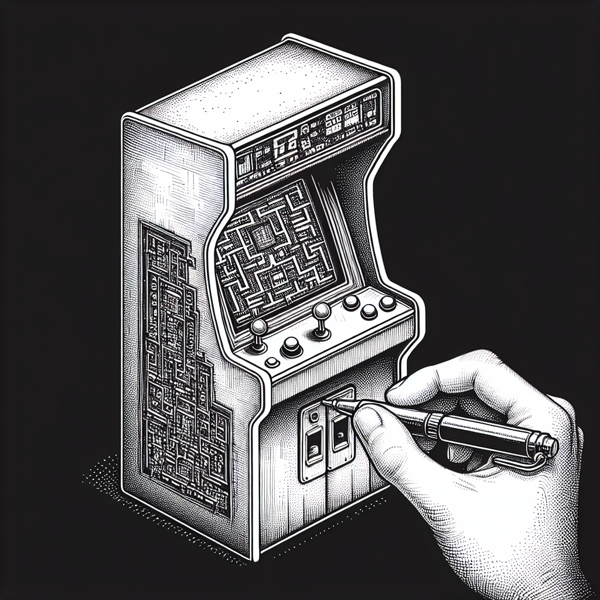
Andrew Mayne, Brian Brushwood, and Justin Robert Young, with a special appearance by Bella, embark on a journey through the latest in nano technology, showcasing a nano-scale video game that could revolutionize biomedical engineering and nanotechnology. They explore the advancements in AI, particularly in workflow automation and the challenges of nano-tech. The conversation shifts to the potential of AI in enhancing scientific experiments and the practical applications of automation in improving efficiency. The trio also touches upon the upcoming Starship launch, placing a friendly wager on its outcome. Throughout, they share their latest media picks and muse on the future of AI and human creativity.
Picks:
Brian: Reset by Dan Heath
Justin: Severance
Andrew: Mickey Mouse cartoons by Paul Rudish on Disney+
Episode Notes
The episode opens with Andrew describing a workflow automation he built in n8n to collect story ideas and email him a pre-show list, then moves into a discussion of a research team creating the world's smallest shooting video game with nanoscale technology. The hosts react to the demonstration, compare it to miniature hockey or "inner space," and Andrew reflects on how nanotech has proved much harder than early optimism suggested.
From there, the conversation broadens into AI-assisted science, automation workflows, and the practical use of tools like make.com and n8n for email-driven systems. Later segments cover model quality and reasoning systems, reactions to Grok voice mode, a Starship launch bet, and the picks segment, which includes Reset, Severance, Mickey Mouse shorts by Paul Rudish, Friendly Neighborhood Spider-Man, and X-Men '97. The episode closes with a discussion of art, Blade Runner studies, and broader worries about AI reshaping human work and status competition.
Key topics
- Nanoscale manipulation with electron microscopy: The hosts discuss a "world's smallest shooting video game" built with nanoscale technology, including focused electron beams and force fields between nanoparticles.
- Nanotech hype versus real-world difficulty: Andrew contrasts earlier expectations of rapid nanotech breakthroughs with the reality that building stable nanoscale systems is much harder than hoped.
- AI-assisted science and materials discovery: They talk about using AI and machine learning to run simulations, control electron microscopes, and support materials discovery, especially in semiconductor-related work.
- Email-based workflows and personal productivity automation: The conversation covers automated systems that send emails, wait for replies, log responses, and route tasks through tools like n8n and make.com.
- Reasoning models versus base models: The hosts distinguish between single-pass base models and reasoning models that break down queries and work through them, mentioning GPT-4.5, Grok 3, Sonnet 3.7, O3, and R1.
- Critique of performative authenticity online: Andrew and Justin mock the practice of manufacturing sentimental posts like "my child said this to me" for LinkedIn-style pseudo-authenticity.
- Disney animation and superhero adaptations: They discuss Paul Rudish's Mickey Mouse cartoons, Friendly Neighborhood Spider-Man, and X-Men '97, with Brian praising the art style but preferring the more nuanced execution of X-Men '97.
- Artistic study and composition: Brian describes Penelope's Blade Runner character study and the way composition alone can communicate a scene's meaning.
- AI, abundance, and future status competition: Brian argues that as artificial systems handle more necessities, people may compete more through communication, creativity, networking, and status rather than survival labor.
Picks
- Brian Brushwood: Reset by Dan Heath — Strong recommendation for a short nonfiction audiobook about systems and changing how you see them.
- Justin Robert Young: Severance — Clear enthusiastic recommendation; he explicitly says it is "so good."
- Andrew Mayne: the Mickey Mouse cartoons by Paul Rudish — Explicitly recommended as fun and really well done Disney+ shorts from the last decade or so.
- Brian Brushwood: Friendly Neighborhood Spider-Man — Positive but mixed recommendation; he praises the art style and some storytelling choices but says some themes feel heavy-handed.
- Brian Brushwood: X-Men '97 — Recommended favorably by comparison; Brian describes it as cool and says he enjoyed it thoroughly.