The Quest for a Silent Burrito Delivery
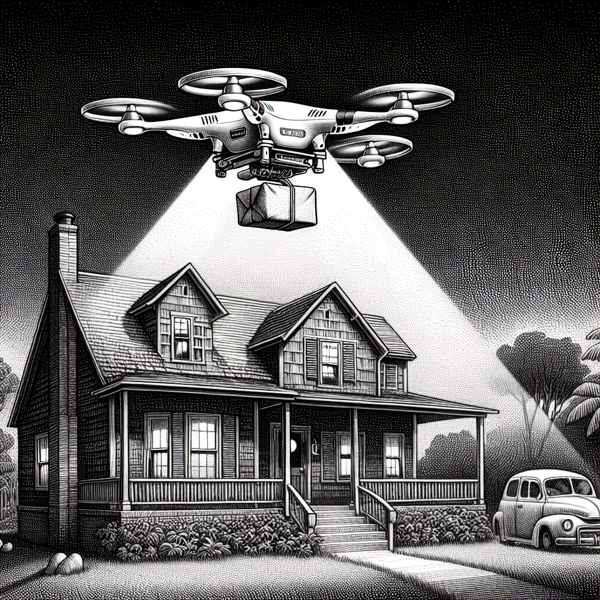
In this episode, Andrew Mayne, Justin Robert Young, and Brian Brushwood dive into a discussion that starts with Justin’s craving for a burrito and evolves into a conversation about the future of delivery services, including drones and autonomous vehicles like Waymo and Zoox. They explore the implications of AI advancements for space exploration, particularly on Mars, and the ethical considerations of colonizing planets with existing ecosystems. The trio also touches on the potential for AI in scientific research and ends with a speculative journey into a cave, humorously debating the essentials one might need, from snacks to an air horn.
Picks:
Justin Robert Young: The Wire Season 2
Brian Brushwood: The Sopranos
Andrew Mayne: The Eagle
Episode Notes
The episode opens with the hosts joking about wanting burritos immediately and turns into a discussion of faster delivery systems. Andrew introduces Zipline's drone-delivery model, describing how it keeps the aircraft high above the ground and lowers cargo by line to avoid noise and landing-safety problems. That leads naturally into a broader conversation about autonomous transport, including Waymo's route-based ride service and Zoox's purpose-built vehicle design, along with speculation about future mobile rooms, containers, and other vehicle-as-space ideas.
The middle of the episode moves through AI and brain-interface ideas. The hosts discuss an AI-only social network, using ChatGPT as a vocabulary and etymology aid, and then a playful cave-packing exercise that leads into a real cave story about Cheetos left in Carlsbad Cavern and the microbial ecosystem it supported. From there they broaden into Mars ethics, robotic exploration, AI tool-building and sunk-cost thinking, before ending with a long entertainment segment on The Wire, The Sopranos, and Beetlejuice Beetlejuice, plus praise for Michael Keaton.
Key topics
- Drone delivery designed to stay aloft: Andrew describes Zipline as a delivery system that drops cargo from a drone hanging high in the air, avoiding the safety and noise issues of landing on a porch or sidewalk.
- Autonomous vehicle design tradeoffs: Waymo is discussed as a mapped driverless ride service, while Zoox is framed as a boxier, purpose-built autonomous vehicle with more interior space.
- The imagined future of mobile rooms and container-like vehicles: The hosts speculate about autonomous vehicles becoming mobile offices, travel rooms, tiki bars, or containers on wheels.
- AI as a personalized social environment: Andrew describes a social AI network where everyone except the user is an AI and the user gets constant flattering attention.
- Chatbots as etymology and vocabulary tutors: Brian explains using ChatGPT to define unfamiliar words and explore their origins, especially older words with stable histories.
- Cave-expedition supply brainstorming: The group riffs on what to pack for a cave expedition, mixing practical gear with joke items and food.
- Snack contamination in caves and cave ecosystems: A bag of Cheetos left in Carlsbad Cavern is used as an example of how a small human mistake can alter a cave ecosystem by feeding microbes and cave life.
- Mars life versus Mars colonization: They discuss how discovering life on Mars would complicate or block future colonization plans.
- Robots versus humans for exploration: The hosts compare robotic exploration with human exploration, noting robots are cheaper and safer but humans currently gather more useful data.
- Sunk cost fallacy in technology and projects: Brian's insurance anecdote and Andrew's comments lead into a discussion of how legacy thinking can block better rebuilds.
- AI-assisted science and data overload: They note that scientific projects and telescopes are producing more data than people can analyze, and that current AI tools are still immature.
- AR device limitations: field of view, occlusion, and value: The hosts criticize AR devices for narrow field of view, clipping, lack of occlusion, and the need to be useful enough to justify their cost and visibility.
- Ultrasound and transcranial brain stimulation: Andrew describes an ultrasound-based noninvasive brain-interface company, and Brian mentions electromagnetic stimulation as another approach.
- Silent or discreet speech communication: Brian imagines a future system for mouthing words silently and having them reconstructed, and the group mentions fMRI and body-based alternatives like Braille or Morse code.
- The Wire Season 2 versus Season 3: Justin says Season 2 is the least interesting season for him, while Season 3 is the best, though he still likes the dock and drug-connection material in Season 2.
- The Sopranos as a therapy-centered gangster show: The hosts discuss The Sopranos as a mob show sold through the gimmick of therapy, but praised for its cast, writing, and pilot.
- Michael Keaton’s range and Beetlejuice’s creative world: They praise Michael Keaton's performance in Beetlejuice Beetlejuice and discuss how much of the original Beetlejuice character came from Keaton's own improvisation and choices.
Picks
- Justin Robert Young: The Wire Season 2 — A rewatch mention rather than a strong endorsement; he calls it his current watch and discusses it affectionately, but also says it's the least interesting season.
- Justin Robert Young: The Sopranos — Clear positive recommendation based on a rewatch of the first episode; he says it holds up and praises the cast and execution.
- Andrew Mayne: The Eagle — Mildly positive but explicitly non-committal; he says it is not perfect, but he enjoyed it and would revisit it every so often.
- Andrew Mayne: Beetlejuice Beetlejuice — Clear positive pick; he says it is really fun and that he loved it once it gets going, despite a slow start.